|
Restart Tutorial
Table of Contents Tutorials Home |
4: A FEW VERBS
An individual dancer can be facing in any of four directions. So almost all turning actions in square dancing involve turning 1/4 of a circle (90 degrees), or some multiple of that (1/2, 3/4).
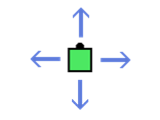
The term for turning in place 1/4 of a circle -- the "verb" that has that meaning -- is Face. This will be followed by a direction, such as right. The direction modifies the verb, kind of like an adverb. So Face Right means turn 1/4 (90 degrees) to the right, from the dancer's perspective (clockwise as viewed from above).

Face Left means turn 1/4 (90 degrees) to the left, from the dancer's perspective (counter-clockwise as viewed from above).

The direction can also be specified with reference to another dancer. For example, Face Your Partner means that each dancer should turn 1/4 toward his or her partner.

This example illustrates something else about actions in square dancing. It is very often the case that dancers who start holding hands must first drop hands before moving. This is generally true for any action when the dancers in a couple or line are not all turning and moving together in the same direction.
The directions "In" and "Out" mean toward or away from the center of the whole square. But whatever the direction, the turn is always 1/4.
The term for an individual dancer turning halfway around (180 degrees), to face the opposite direction, is U-Turn Back. In most cases, the dancers do this by turning toward their partner.

When the dancers are done with an action, if they are again standing next to another dancer, side by side, they will join hands. It might be the same person, as in this case, or a different person. This dropping and rejoining hands is implicit -- it is not included in the description of a particular action, and the caller won't mention it explicitly.
| PREV | NEXT |