|
Restart Tutorial
Table of Contents Tutorials Home |
3: A FEW NOUNS
We will start by introducing some "nouns" -- terms that identify dancers and groups of dancers. In this tutorial, terms that are part of the "square dance language" itself, ones that you need to learn in order to understand what the caller is saying, will be shown in bold. Other terms that are being used here just to explain the language will be shown when they are introduced in italics.The two fundamental units of square dancing are the individual dancer and a square of eight dancers. While they are dancing, the dancers interact in terms of formations of various sizes, almost all of which are composed of two dancers, four dancers, or eight dancers.
In the diagrams in this tutorial, the small circular bump represents the facing direction of a dancer -- you can think of it as a "nose".

The simplest formation is two dancers standing side to side, holding hands -- this is called a couple, and the two dancers in a couple are referred to as partners.
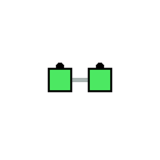
Two dancers can be directly facing each other.
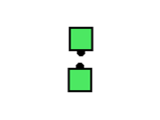
They can also be directly back-to-back.

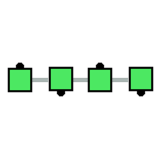
Four dancers standing side to side, all holding hands, is called a line. If the dancers in a line are all facing the same way, it is called a one-faced line.
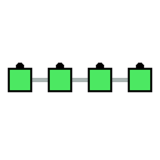
But the dancers don't have to be facing the same direction. If a line consists of two couples facing opposite directions, it is called a two-faced line.
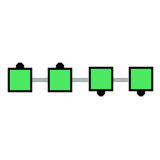
If the dancers are facing in alternating directions individually, it is called a wave.
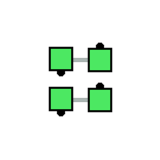
Four dancers can also be arranged in a 2x2 box. A box may consist of facing couples, or back-to-back couples.
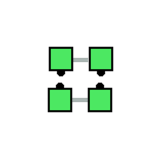 Facing Couples |
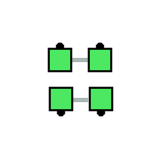 Back-to-Back Couples |
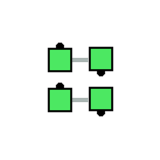 |
 |
Doesn't sound too hard so far, does it? Except for "wave", all of these terms are pretty closely related to the basic English meaning of the words.
Now let's look at some "verbs"...
| PREV | NEXT |