|
Restart Tutorial
Table of Contents Tutorials Home |
17.2: LINES AND BOXES
When the eight dancers are arranged in parallel lines, they form two lines. So they can do actions that make sense in a single line. If they are in parallel one-faced lines, they can do any action that makes sense in a single one-faced line. If they are in parallel two-faced lines, they can do any action that makes sense in a single two-faced line. The dancers in each line do the action at the same time, with the three other dancers in their own line. Nobody from one line moves into the other line.
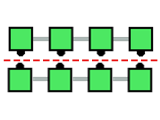
But at the same time, the eight dancers can be viewed as two boxes, so they can do any action that makes sense in a box. In that case, the four dancers in each box do the action at the same time, with the three other dancers in their own box. Nobody from one box moves into the other box.
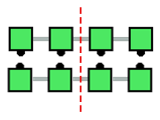
For example, the dancers in parallel facing lines can be viewed as two pairs of facing couples. So in addition to actions that make sense in a one-faced line, they can also do any action that makes sense in one pair of facing couples. For example, they can do a Right and Left Thru.

The caller doesn't need to tell the two boxes to do the action at the same time. If the set of eight dancers is in a formation where it would make sense for each half to do the action independently, that is implied.
The principle of the four dancers in each group doing a four-dancer action independently applies even if the action changes a line into a box or vice versa. For example from parallel lines, Bend the Line turns each line into a box.

The two new boxes simply end up adjacent to each other, in the same way that the two lines originally started adjacent to each other.
| PREV | NEXT |